Last reviewed September 15, 2026. This page provides general information, not legal advice. Laws and enforcement guidance can change. Review the current statute or consult a qualified professional about a specific vehicle.
What Is the Legal Tint in Hawaii?
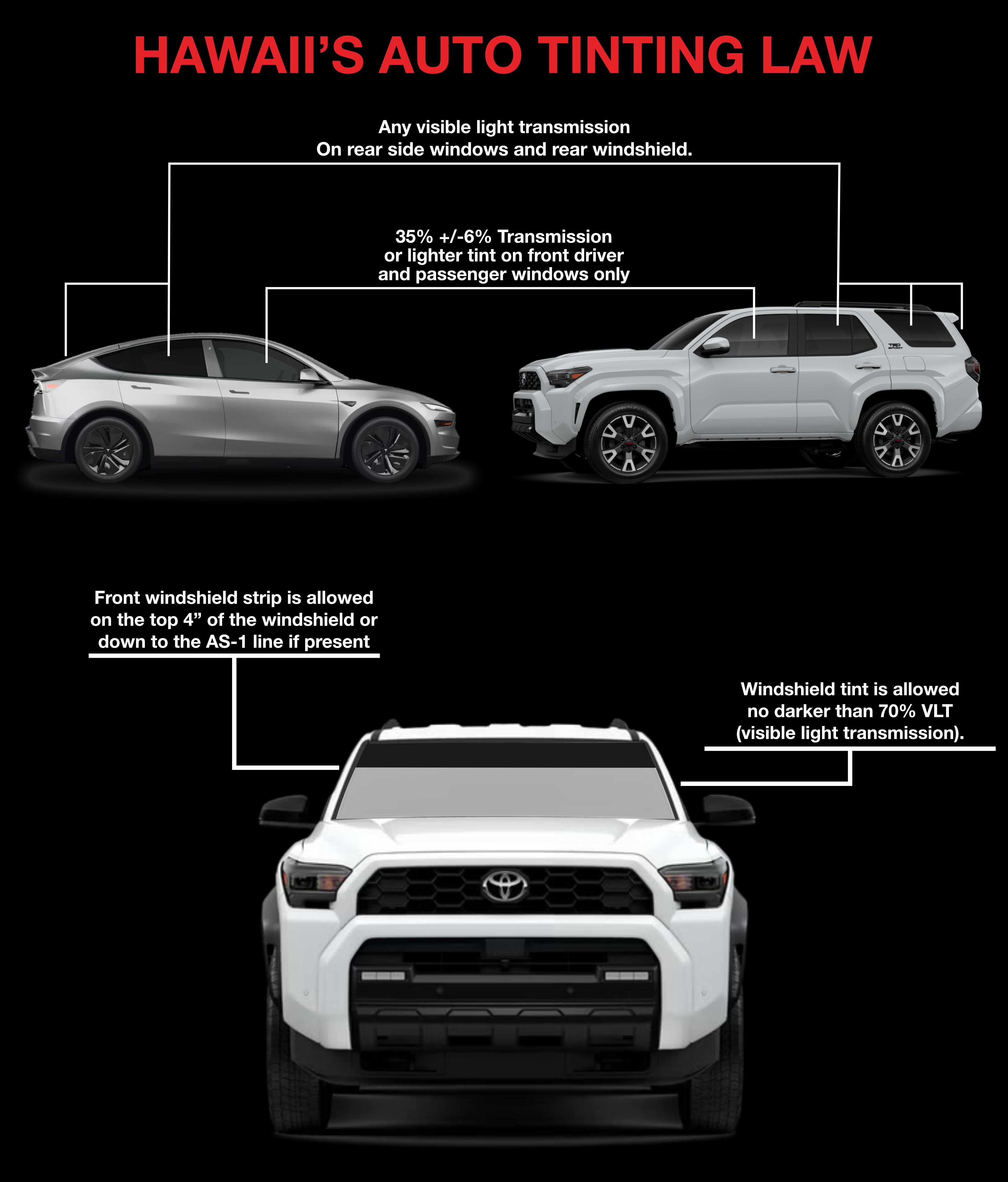
Hawaii law generally permits qualifying sun-screening devices on front side windows when the combined glass and film allow at least 35% visible light transmission, with a tolerance of plus or minus 6%. Different rules apply to the windshield, rear windows, vehicle type, mirror configuration, film color, and reflectivity.
The controlling source is Hawaii Revised Statutes §291-21.5. Hawaii revised this section through Act 129, approved May 29, 2025.
Hawaii Tint Limits by Window Location
| Window or condition | Current statutory rule in plain language |
|---|
| Front side windows and qualifying wing vents | Combined glass and film must provide at least 35% VLT, plus or minus 6%. |
|---|
| Windshield top strip | A transparent strip may be used along the top edge if it does not extend into the AS-1 area, or more than four inches below the top when no AS-1 mark is present. |
|---|
| Other transparent windshield material | Material applied to the AS-1 portion must comply with Federal Motor Vehicle Safety Standard 205. |
|---|
| Rear windshield and windows behind the driver | The statute provides exemptions for listed vehicle windows when the vehicle has rearview mirrors on both sides. |
|---|
| Color and reflectivity | Mirrored or highly reflective finishes that appear red, yellow, amber, or blue from outside are prohibited. |
|---|
VLT means visible light transmission: the percentage of visible light that passes through the glass-and-film combination. A lower number means a darker result. Compliance is based on the finished window, not only the film's advertised shade.
What Changed Under Hawaii Act 129?
Act 129 updated Hawaii's motor-vehicle tint statute in 2025. It clarified front-side and rear-window rules, prohibited specified highly reflective colors, required occupants with applied tint to roll down their windows during a traffic stop subject to stated exceptions, increased owner and installer fines, and strengthened the installer's compliance-certificate requirement.
Safety Inspections, Certificates, and Penalties
Hawaii's required vehicle safety inspection includes a test for compliance with the tint statute. The installer must issue the vehicle owner a certificate stating that the installed device complies with the law, and the certificate must remain in the vehicle.
HRS §291-21.5 states that an owner violation may carry a fine of $300 to $550 per offense. An installer violation may carry a fine of $700 to $1,200 per offense, along with specified correction or reimbursement obligations.
Common Hawaii Tint-Law Questions
What percentage tint is legal in Hawaii?
For qualifying front side windows and wing vents, the current statute specifies at least 35% visible light transmission, plus or minus 6%, for the combined glass and film. Other windows and vehicle configurations have different rules.
Is 20% tint legal in Hawaii?
A 20% finished VLT would generally be darker than the front-side-window standard in HRS §291-21.5. Rear-window exemptions may apply to listed windows when both side mirrors are present. Confirm the exact window and vehicle before installation.
Does ceramic tint have a different legal limit?
No. Ceramic describes the film technology, not a separate legal darkness category. Legal compliance depends on final visible light transmission, window position, vehicle configuration, and other statutory conditions.
Can I tint the windshield in Hawaii?
Hawaii law allows limited transparent material in the windshield areas described by the statute and federal safety standard. A top strip must stay within the AS-1 boundary or the alternative four-inch limit described in the law.
Are rear windows allowed to be darker?
The current statute exempts listed rear windshields and side windows behind the driver when the vehicle is equipped with rearview mirrors on both sides. Vehicle configuration still matters.
Do I need a tint certificate in Hawaii?
The current statute requires the installer to issue a compliance certificate to the vehicle owner and requires that certificate to be stored in the vehicle.
What happens during a traffic stop?
The statute requires drivers and passengers of vehicles with applied tint to fully roll down their windows when stopped by law enforcement, subject to exceptions for physical disability or mechanical failure when the person communicates or cooperates by other reasonably available means.
Choose Tint for Hawaii Heat and Legal Compliance
Identify the exact vehicle and windows, account for factory glass, choose film based on final combined VLT, and retain the installation receipt and required compliance certificate. Compare auto tinting in Honolulu, ceramic window tint, windshield heat-rejection options, and the best tint for Hawaii heat.
Request a Tint Estimate Call Airport: (808) 423-8468

 .
.  .
.